How Many Cubic Yards in a Dump Truck? Sizes and the Weight Limit by Material
By Erdi Doğan, owner and editor ·
Drafted with AI assistance; every number checked against the cited source.

A standard tandem-axle dump truck holds about 10 to 16 cubic yards, and a typical delivery is 12 to 14 yards. Small single-axle trucks carry about 5 to 8 yards, and tri-axle trucks 14 to 20. But for heavy material such as dirt, sand or gravel, the truck usually hits its legal weight limit before its bed is full, so a "full load" of gravel is often only 8 to 12 yards. Below are the size classes, the weight math for each material, and how to turn your project into a number of loads. To size the job first, use the topsoil calculator or the gravel calculator. The landscaping projects hub covers the rest of the job.
Dump truck sizes in cubic yards
| Truck | Bed volume | Notes |
|---|---|---|
| Small dump truck (pickup-type chassis) | about 1.5 cu yd | SANY, a dump truck maker |
| Single-axle dump truck | 5 to 8 cu yd | residential and small commercial jobs |
| Tandem-axle (standard) dump truck | 10 to 16 cu yd | common delivery size 12 to 14 cu yd |
| Tri-axle dump truck | 14 to 20 cu yd | higher legal payload |
| Semi end-dump trailer | 22 to 30+ cu yd | large construction jobs |
Those ranges come from a dump truck manufacturer and an engineering explainer (sources at the end). They describe the bed, not what a supplier will put in it. Every truck's real capacity is printed in its documentation, and SANY notes that some manuals give it in cubic meters: 1 cubic meter is about 1.31 cubic yards.
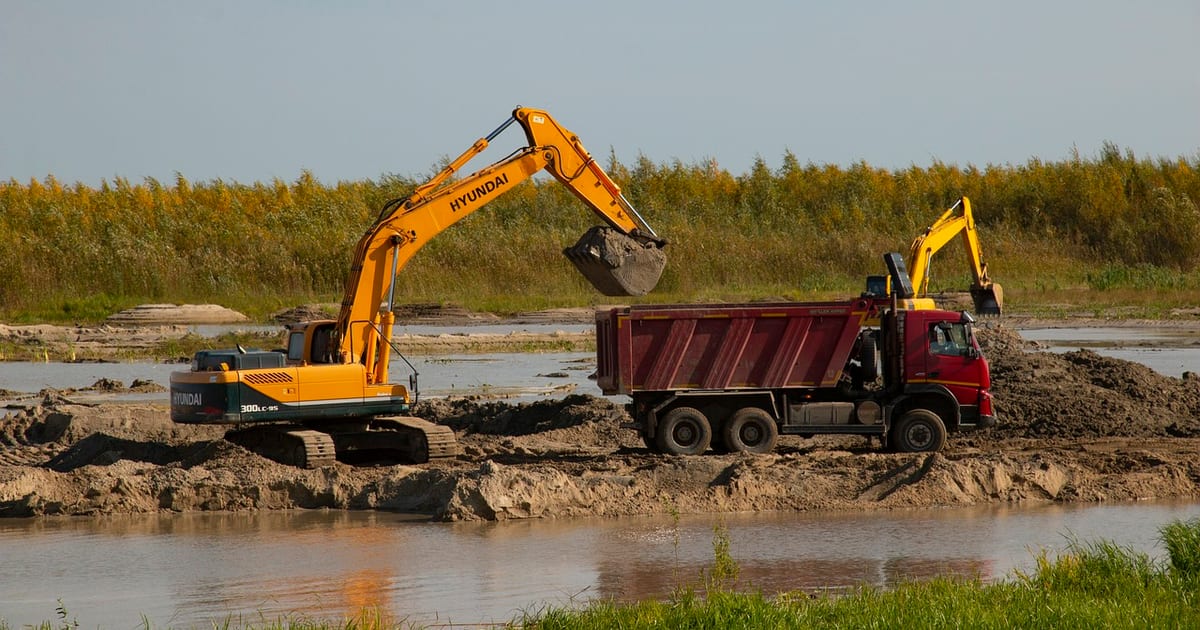
Struck vs heaped: why the same truck carries different amounts
Bed volume is quoted two ways. Struck capacity is the volume with the load level with the top of the sides. Heaped capacity adds the mound that soil and sand form above the rails. Light, loose material is usually delivered heaped, so its delivered volume leans toward the higher figure. When you compare quotes, ask which one the supplier means.
Why heavy loads stop short: the weight limit
Trucks are limited by weight on every axle. On the Interstate System, federal law caps a single axle at 20,000 pounds, a tandem axle at 34,000 pounds and the whole vehicle at 80,000 pounds, and the Federal Bridge Formula can lower the limit further for groups of axles (FHWA). Off the Interstate, states set their own limits. The empty truck counts toward those limits, so the payload left over is what decides how much heavy material fits.
That is why the same truck "weighs out" with gravel but "volumes out" with mulch. To show how big the effect is, we divided two example payloads by the weight of a cubic yard of each material, using the densities from our calculators:
| Material | Weight per cu yd | Yards in 12 tons (24,000 lb) | Yards in 15 tons (30,000 lb) |
|---|---|---|---|
| Hardwood mulch | 600–800 lb | 30–40 (bed fills first) | 37–50 (bed fills first) |
| Topsoil | about 2,400 lb (1.2 tons) | 10 | 12.5 |
| Sand (mason) | 2,620–2,700 lb | 8.9–9.2 | 11.1–11.5 |
| Pea gravel | 2,500–2,700 lb | 8.9–9.6 | 11.1–12.0 |
| Gravel, dry | about 2,835 lb | 8.5 | 10.6 |
The 12- and 15-ton payloads are examples, not the rating of any particular truck; your supplier knows its own trucks' legal payload. The pattern holds either way: a 14-yard truck can carry a full bed of mulch, but only around 8 to 12 yards of gravel, sand or soil. The engineering explainer cited below reaches the same conclusion, putting dense material such as sand or crushed stone at 8 to 10 yards per load.
How many loads do I need?
- Work out the cubic yards for the job with the topsoil, gravel or mulch calculator, or convert any dimensions with the cubic yard calculator.
- Ask the supplier two numbers: the bed size of the truck they will send and the most it can legally carry of your material, in tons or yards.
- Divide and round up. For example, 20 yards of topsoil with a truck that carries 12.5 yards of it is 1.6 loads, so plan for 2 deliveries, or ask whether a larger truck can do it in one.

How many yards of dirt are in a dump truck?
For topsoil at about 1.2 tons per cubic yard, a standard tandem truck usually carries roughly 10 to 13 yards, depending on its legal payload: 10 yards in a 12-ton load and 12.5 in a 15-ton load. Wet soil weighs more, so expect less. Fill dirt and clay vary widely, which is one more reason to ask the supplier how many yards or tons the truck will actually bring.
Sources
- SANY Group, "How Many Cubic Yards In A Dump Truck? Load Capacity & Buying Guide," sanyglobal.com/blog/how-many-cubic-yards-in-a-dump-truck, opened 2026-10-30 (size classes, cubic meter conversion, check the manual).
- Engineer Fix (L. Cope), "How Many Yards Is a Standard Dump Truck?," engineerfix.com/how-many-yards-is-a-standard-dump-truck, opened 2026-10-30 (single, tandem, tri-axle and end-dump ranges; struck vs heaped; dense loads 8 to 10 yards).
- Federal Highway Administration, "Bridge Formula Weights," ops.fhwa.dot.gov/freight/publications/brdg_frm_wghts, opened 2026-10-30 (20,000 lb single axle, 34,000 lb tandem, 80,000 lb gross on the Interstate System).
- Mulch Mound, "How Many Tons of River Rock Do You Actually Need" (hardwood mulch 600–800 lb and pea gravel 2,500–2,700 lb per cubic yard), "Sand Delivery" (mason sand 1.35 tons per cubic yard) and "Sand vs Topsoil Over Subsoil" (topsoil about 1.2 tons per cubic yard), mulchmound.com.
- The Engineering ToolBox, "Dirt and Mud: Densities" (dry gravel 105 lb per cubic foot; dry sand 97 lb per cubic foot), engineeringtoolbox.com.